
The Grey North
reflecting on Édouard Louis

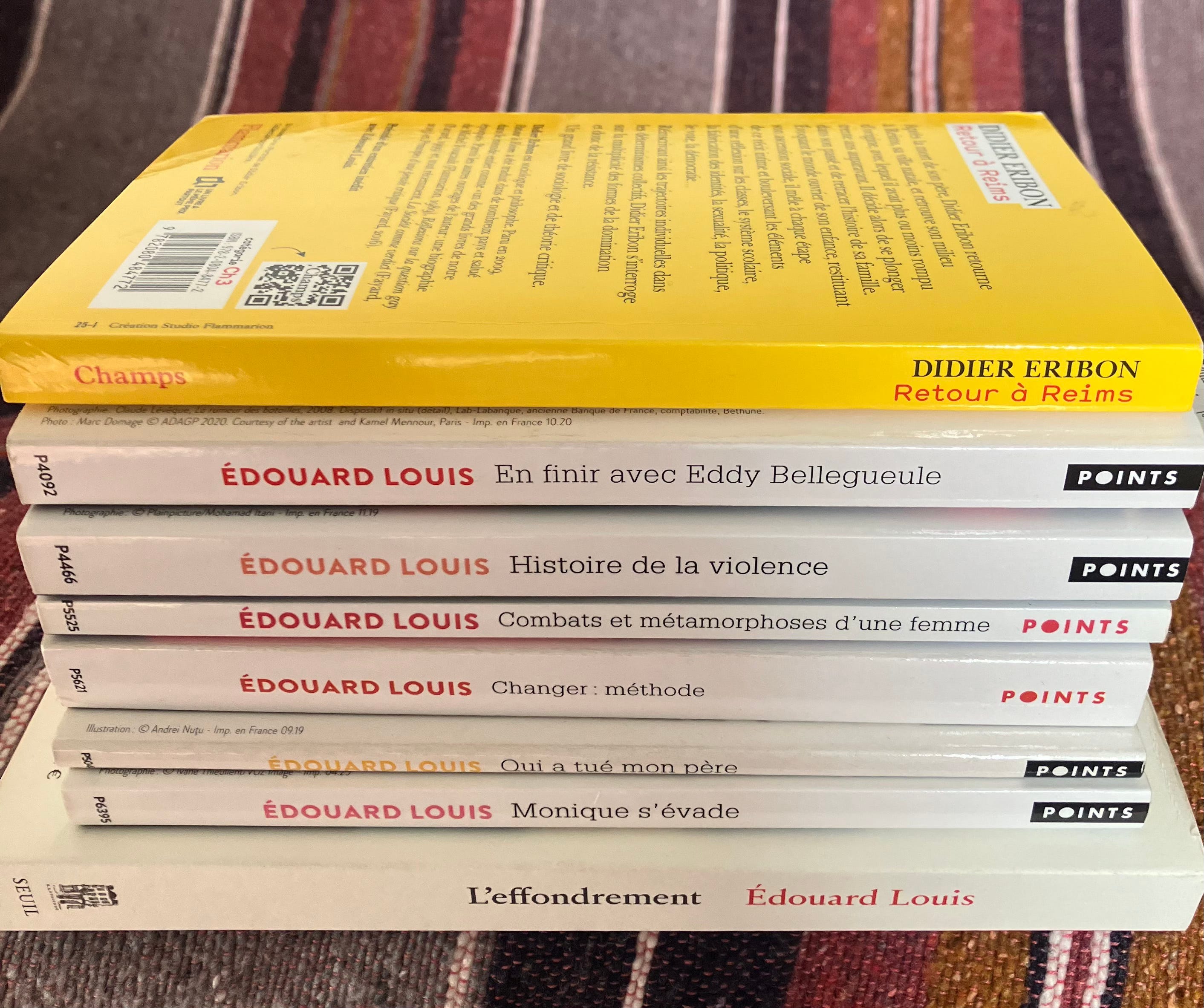
I have been reading overt the past year or so – thanks to a friend who alerted me to his work (thank you Michèle!) – the French writer Édouard Louis who writes about his awful childhood in the broken half-rural, half industrial landscape of Northern France – what he calls le grise du Nord. For someone like me who reads French1 but not with the confident fluency of a genuine bilingual – and my spoken French is, as one would expect of an Englishman, pretty hopeless – Louis writes a clear, forceful, direct prose all the more powerful for its lack of unnecessary embellishment. (Setting aside some brief passages of Picardy dialect that I managed to cope with.)
In half a dozen autobiographical ‘novels’ or autofictions he has laid bare the bleakness of his family life: the father sitting with his copains in front of the TV drinking pastis, the mother a domestic slave, the pair of them reduced to even more menial jobs when the father’s back is destroyed in a factory accident and he ends up as a refuse collector, while his wife cleans up the elderly and incontinent as a care assistant, the children sometimes sent to beg relatives for some pasta so they could eat an evening meal.
Édouard Louis, on top of this, had to contend with the fact that he was gay in a culture that despised such an orientation. He is beaten up and spat on at school and there is scant sympathy from his own family. Everywhere he encounters what he calls L’Insulte, always capitalised, the principal term of hate in the French lexicon of homophobia: pédé. For Louis, there is only one way out: escape from the North. He attends the nearest lycée at Amiens and the process of alienation from his family begins as he encounters other worlds. He makes friends with a fellow-student, Elena, whose bourgeois parents read books, listen to classical music, eat good food, and surround him with a more civilised ambient than he has ever known. Delicately, Elena even teaches him how to handle a knife and fork. She also takes him to hear a visiting writer called Didier Eribon, philosopher and sociologist, who turns out to have come from a similar background to Louis. The latter is spellbound. Here is someone who understands his predicament, the need to fly from ignorance and homophobia, the need to remake himself totally. Louis has hardly read a book at this stage in his life but he wolfs down Eribon’s Retour à Reims, recognising his own story there.
In Return to Rheims, Erebon discusses what he calls the “beautiful and powerful” analytical concept of the French sociologist Pierre Bourdieu: habitus clivé. A rather unlovely phrase this means the condition of those – like himself and Louis – who cannot live in the world (habitus) that they grew up in, that was their inheritance, their apparent destiny, because they find their relationship to it to be broken (clivé or cleft). Escape is the only answer and in Louis’ case this means a radical remaking of himself. He changes his name (originally christened Eddy Bellegueule [‘pretty face’]) to Édouard Louis, his own family mocking him for dispensing with Eddy in favour of Édouard as if he is trying to show he is too good for them. He justifies this repudiation of his working class background on the grounds that it was a world that hated him and what he was, his sexuality and his difference. His remaking becomes “my revenge on my past” (ma rivanche sur ma passé).
The encounter with Erebon teaches Louis that Amiens is now a mere staging post on the way to real liberation: Paris. He starts to visit at weekends but eventually moves there, living in a flat provided for him by one of the rich gay men in whose circles he quickly finds himself moving, and who pays the enormous bills for private dentistry which his neglected Northern mouth is now seen to require. Louis reads ferociously, making up for lost time, goes to the opera, eats at expensive and exclusive restaurants and tries, initially with great difficulty, to write.
“I wrote in order to exist,” he says. J’écrivais pour exister.
This story is one that runs counter in many ways to the conventional British class narrative where upward mobility can, in a sense, be seen as a kind of curse. Why, we ask, is this painful and divisive trajectory imposed on us? Why can’t we be happy just to honour our class origins? Unlike the usual British way of talking about class – usually through ritual cultural markers rather than in a hard analytical fashion – Louis and Erebon have studied their sociological texts and remain convinced that the politics of class domination are at the centre of the story. But at the same time that political reality is precisely what made the escape from le grise du Nord necessary for both.
Many other disadvantaged groups in society are defiant, celebrating what they are, challenging anyone who tries to disparage them. But Louis and Erebon saw their personal solution only through escape, radically remaking themselves, not out of snobbish distaste for their origins but as an act of vital liberation. The vicious, homophobic worlds in which they were trapped gave them, they would say, no choice. They did not choose this bundle of hate and prejudice and cultural deprivation that had been forced on them.
Louis dramatises these conflicts in interesting ways and many of the books return to the same ground, trying to come at this narrative in different ways but at the heart of his struggle is the need to break away, to be able to express himself, to be free.
And narratives of freedom are always inspiring.
Many of Louis’ books are available in English: https://www.penguin.co.uk/books/427858/the-end-of-eddy-by-edouard-louis/9780099598466
This is fascinating. Nicholas -- I was drawn to that question at the centre of the writers who "remain convinced that the politics of class domination are at the centre of the story. But at the same time that political reality is precisely what made the escape from le grise du Nord necessary for both." From an earlier generation that matches my experience of escaping le grise du Nord, except it was heavilly industrialised Teesside with sprawling extended family, fiercely working class (or underclass on my mother's side) and deeply racist, homophobic and antagonistic to 'difference' (which made me a zoo animal for buying books and being academic). I think I was luckier that Louis for having other adults (paternal grandparents with an unusually wider view, though probably not abou race and gender) outside my dysfunctional nuclear family -- teachers, a local priest... -- and a friend whose home was entirely different and let me glimpse another world in my teens. Yes -- working class culture has a lot of ritual markers, some that are honed as survival and mutual support, but I've always felt there's a lot of romanticisation of a culture that can be viciously othering and glorifies anti-inellectualism. My route was also out, though my roots still show.